
Making a comeback: whales, numbats, condors and mangroves

ENVIRONMENT/ANIMALS

Humpback whales, Australia’s marsupial the numbat, condor eagles and mangroves are all moving back from either rapid decline or the edge of extinction.
Humpback whales
July 2, 2026
More humpback whales have been sighted off Rio de Janeiro’s coast as they recover from decades of commercial whaling, prompting a boost in demand for whale-watching excursions during their annual migration.
The species’ population has jumped from around 2,000 to around 35,000 in the last 40 years, close to their population before whaling, says Enrico Marcovaldi, co-founder of the Humpback Whale Project.
In 1982, the International Whaling Commission declared a halt to commercial whaling on all whale species and populations from the 1985-1986 season onward.
Humpback whales are known to roam long distances across major oceans in predictable patterns, typically following migration routes learned from their mothers. They feed on krill and small fish in the warmer months and breed in tropical waters over winter. Between June and November, thousands of humpback whales migrate through Brazilian waters, travelling roughly 4,000 kms from their feeding grounds in the Southern Ocean to breeding and calving grounds off northeastern Brazil.
ABOVE A humpback whale breaches off the coast of Rio de Janeiro, Brazil, June 30, 2026
PHOTO AP Photo/Dhavid Normando
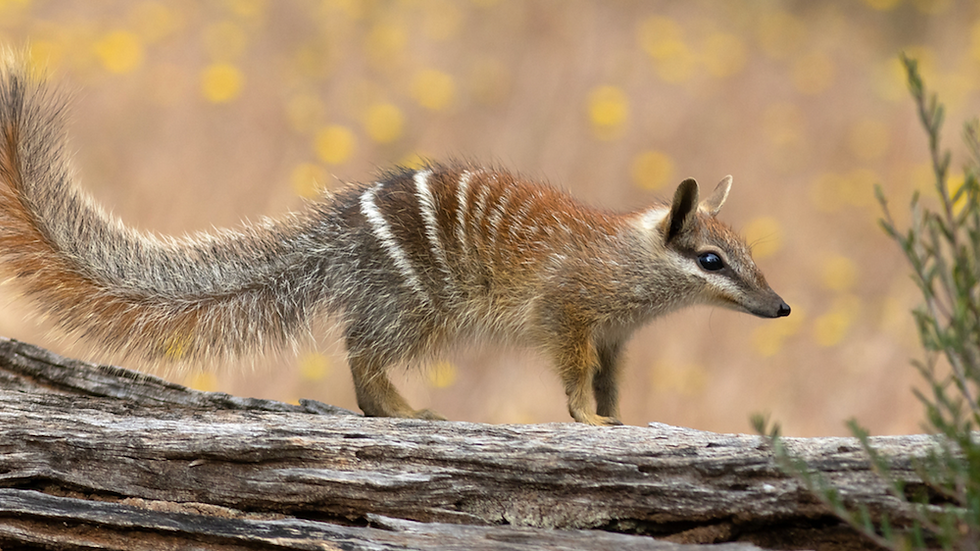
The numbat
July 10, 2026
The animal emblem of Western Australia, the numbat, is recovering after decades of conservation efforts, reports the IUCN, the global wildlife conservation authority. For decades, the numbat or banded anteater (Myrmecobius fasciatus) was listed as endangered on the IUCN Red List. It has now been moved to the lower threat category of near threatened.
“The ‘downlisting’ of the numbat on the IUCN Red List from Endangered to Near Threatened is what we have been working for over the last 40 years!” says Tony Friend, research associate at the WA Department of Biodiversity, Conservation and Attractions (DBCA). “Consequently, I feel very elated that the more secure status we’ve been able to achieve with the numbat has been recognised by IUCN.”
The striped, ant-and-termite-eating marsupial with reddish-brown fur was once on the verge of extinction. By the late 1970s, a mere 300 individuals remained. Their decline was primarily driven by the introduction of predators, such as the red fox and the domestic cat, as well as habitat destruction and changes in the intensity and frequency of fires.
This year, numbat numbers have grown to about 2,000–3,000 individuals thanks to the efforts of wildlife scientists, the DBCA, Perth Zoo, conservation organisations and community volunteers.
Conservationists have, for example, baited and removed foxes and feral cats from certain areas, which has resulted in “spectacular increases in numbat numbers in the two original populations, both in Western Australia: one of these has been shown to number up to 2,000 now,” says Friend.
Conservation teams have also built fenced areas to keep non-native predators out and establish new populations using translocated wild and zoo-bred numbats.
Despite the numbat’s promising recovery, Friend urges caution. Its overall numbers, at around 3,000 “are still very low for an entire species,” he notes. “[T]his success has only been achieved by a huge sustained effort in controlling introduced predators, the effort must continue or the numbat will quickly fall back to low levels or into extinction.”
ABOVE The numbat
PHOTO Kym Nicolson via iNaturalist (CC BY 4.0)

The condor eagle
March 20, 2026
A pair of California condors reintroduced to the Pacific Northwest by the Yurok Tribe appears to have established the species’ first nest in the region in more than a century, nesting in a remote old-growth redwood. It’s a milestone for a species whose global population dropped to just 22 individuals in 1982; it has since recovered to 607.
Based on shifts in behaviour and satellite flight data, biologists with the Northern California Condor Restoration Program (NCCRP) have determined the female condor likely laid an egg inside a hollow in an old-growth redwood tree in early February. Her mate has been sharing incubation duties.
“This is a huge moment for our Northern California flock,” says Chris West, NCCRP program manager and Yurok Wildlife Department senior biologist. “It is important to remember these are wild birds. We trap them occasionally for health monitoring, but if they nest, and how successful they are, is totally up to them, with as little interference from us as possible.”
The nest site is too remote for direct visual confirmation, so staff are relying on wing-mounted transmitters and field observations to monitor the pair’s progress. The program is exploring the use of drones to get a look at the nest. The egg, if present, would take 55–58 days to hatch, with both parents taking turns on incubation shifts, a behaviour typical of the species.
The discovery of the nest carries significance for the Yurok people; the California condor is sacred to the tribe, and its feathers and songs are integral to Yurok World Renewal ceremonies.
In 2003, a panel of Yurok elders designated the condor as the top priority for land-based species restoration on their ancestral territory. The tribe spent nearly two decades conducting studies, evaluating contaminant risks, and building partnerships before releasing the first cohort of four condors in May 2022.
The species’ slow reproductive cycle makes every breeding attempt consequential. They nest only every other year, laying just a single egg per clutch, and it takes more than a year of parental care before a chick can fend for itself.
Although the news is hopeful, biologists are tempering expectations. First-time condor parents often fail to hatch their first egg due to inexperience with incubation.
Nonetheless, it is still a cautiously optimistic time for the condor. By 1987, every surviving condor had been captured for a last-ditch breeding program. Reintroductions began in 1991, and have since expanded to sites in Central and Southern California, Arizona, Baja California, and now the Pacific Northwest.
Even so, the species faces persistent threats. Lead poisoning from ammunition fragments in carrion remains the leading cause of condor mortality, and avian flu has killed more than 20 condors in the Southwest flock in recent years.
Twenty-four condors now fly within Yurok ancestral territory, and the NCCRP plans to release at least one new cohort each summer for the next two decades. Whether this new nesting attempt leads to a successful hatching, the fact that reintroduced condors are attempting to breed in their historical northern range represents a meaningful step for a recovery effort more than four decades in the making.
ABOVE California condor flies free in the Yurok territory in Northern California
PHOTO Matt Mais/Yurok Tribe

Mangroves
June 23, 2026
Scientists at Tulane University in New Orleans in the US report that the world’s mangrove forests — critical coastal ecosystems feared to be on the brink of collapse — are making an unexpected recovery overall. As deforestation and degradation have slowed over the past decade around the globe, mangroves are bouncing back.
Satellite data from the past four decades shows an unexpected expansion and regrowth across the world that began around 2010. Gains have almost outpaced losses, so the overall loss since the 1980s has been about 1%. The recovery is predominantly driven by expansion of mangroves into new areas rather than recovery of existing forests. Recovery is not evenly distributed, the data show. Southeast Asia slowed mangrove loss while West and Central Africa have seen accelerated deforestation in recent years due to oil exploitation.
However, scientists have found mangroves are becoming less degraded. A greater proportion are closed-canopy forests, which means they are denser, helping secure shorelines. These closed-canopy sections increased from around half of all mangroves worldwide in the 1980s to about 58% by 2023.
“Our study shows some new ideas about [mangrove] recovery. We find that deforestation and degradation rates are slowing down,” says lead author Zhen Zhang, a postdoctoral scholar at the university’s School of Science and Engineering.
Over the past few decades, mangroves have shrunken globally due to human intrusion in the form of golf courses, agriculture and housing. Natural disturbances such as cyclones and coastal erosion are also damaging mangroves, for example, the mangrove dieback in Texas after a severe freeze in 2021 and damage from Hurricane Ian in Florida the following year. Shoreline erosion and human deforestation are also ongoing.
Although the IUCN Red List of Ecosystems reported in 2024 that about half of the world’s mangroves were vulnerable, endangered or critically endangered, since 2010, global rates have reversed, resulting in a near net gain of mangrove habitat. While it’s difficult to determine one specific reason for the rebound, a combination of restoration efforts, legal protections and natural recovery are the most likely. In river deltas, where newly-formed coastal mudflats create ideal sediment conditions, mangroves have been opportunistic colonisers. There have even been reports of mangroves extending into abandoned aquaculture pools.
“I think we systematically underestimated the ability of mangroves to expand by theirselves,” Zhang says.
Co-author of the study Daniel Friess, a professor of earth and environmental sciences also at Tulane University, says, “We hope this more optimistic story will help conservation by focusing on the successes we’ve already had in reducing deforestation, and by showing how mangroves can grow back if we give them the chance.”
Still, the authors caution against complacency. “Our study doesn’t mean mangroves are totally healthy globally. In many local regions we still see deforestation going on. That’s why we need to conserve them,” Zhang concludes.
ABOVE Cleared mangroves, re-planted in Brazil, 2006
PHOTO Amy Duchelle/CIFOR, Landscape Alliance via Flickr (CC BY-NC-ND 2.0)


Comments